

AI in Healthcare: Smarter Diagnostics for Better Patient Outcomes
Dec 15, 20253 min read
AI SolutionsMobile App DevelopmentWeb Development
Transforming Healthcare with AI: From Early Detection to Precision Decisions
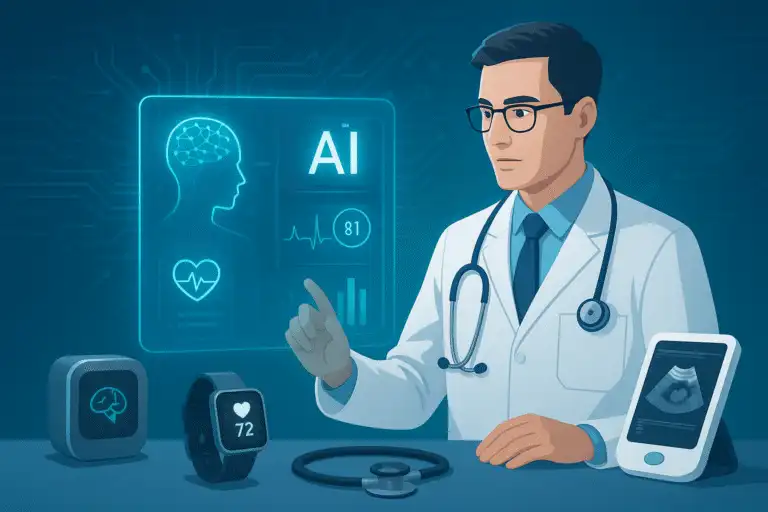
Table of Contents
Introduction
Healthcare is undergoing a major transformation as Artificial Intelligence (AI) accelerates diagnostics and supports better clinical decisions. With the ability to process vast amounts of medical data, AI helps doctors detect patterns that may be invisible to the human eye, enabling early intervention and more precise treatment. It is not replacing clinicians but augmenting their expertise, improving both speed and accuracy in patient care.
From Data Overload to Actionable Insight
Modern healthcare systems generate enormous volumes of data from imaging, lab tests, wearables, and electronic health records. AI converts this complex information into actionable insights, highlighting early warning signs and potential risks. Whether it is identifying anomalies in scans or predicting disease progression, AI reduces cognitive load on clinicians and supports more confident diagnoses, especially in time-sensitive situations.
Enhancing Imaging and Lab-Based Diagnosis
AI-powered image analysis tools are becoming integral in radiology, pathology, and other diagnostic fields. These systems can rapidly analyze X-rays, CT scans, MRIs, and slides to flag suspicious areas for further review. This helps prioritize critical cases, reduce human error, and improve the consistency of readings across different locations. In combination with lab data, AI creates a clearer diagnostic picture that supports effective treatment planning.
Personalizing Treatment and Patient Monitoring
Beyond diagnosis, AI helps tailor treatment strategies to individual patients by analyzing their medical history, response patterns, and risk factors. It supports clinicians in selecting therapies with higher chances of success and fewer side effects. At the same time, AI-enabled monitoring tools track patient vitals and behavior in real time, alerting care teams to potential deterioration before it becomes an emergency.
Conclusion
AI is becoming an essential ally in healthcare, augmenting clinical expertise and making diagnostics faster, more accurate, and more personalized. By turning complex medical data into meaningful guidance, AI helps deliver better outcomes, reduce errors, and elevate the standard of care. As adoption grows, AI will be central to the next generation of intelligent, patient-centric healthcare systems.